
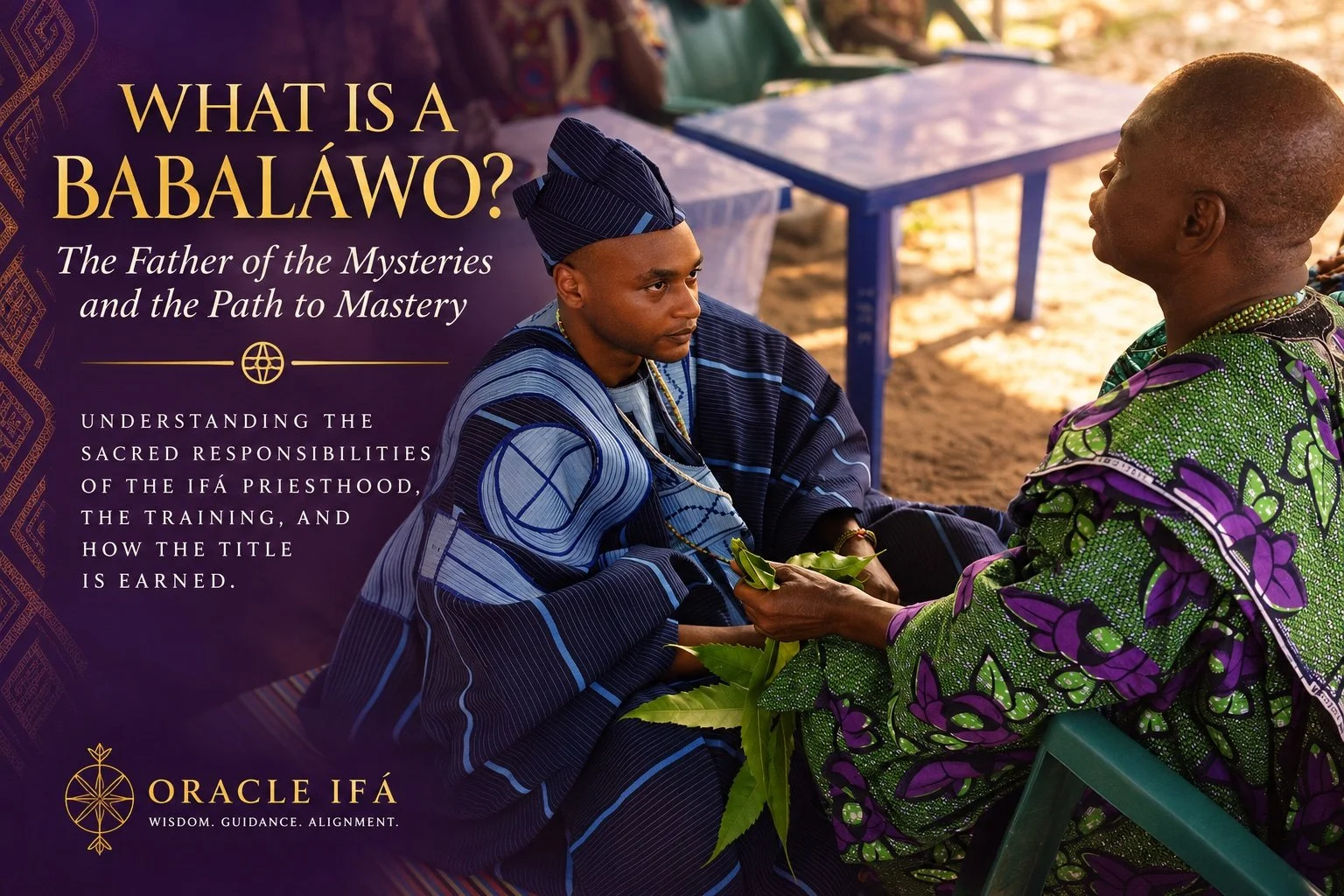
Understanding the sacred responsibilities of the Ifá priesthood, the distinction between initiation and mastery, and the living transmission of traditional knowledge.
By Prof. Dr. Oba Ifagbemi Faseye Babatunde, PhD; ND
Oracle Ifá Knowledge Library | November 24, 2026
The Meaning of Babaláwo
The Yorùbá word Babaláwo is commonly translated as "father of the secrets" or "father of the mysteries."
The name itself communicates something profound about the nature of the responsibility it represents.
To become a father of the mysteries is to become a custodian of sacred knowledge, a guardian of inherited wisdom, and a person entrusted with the responsibility of applying that knowledge in service to others.
It is not simply a designation of religious affiliation, nor is it merely a title acquired through participation in a ceremony.
Within the classical African framework of Ifá, it represents a process of spiritual formation, intellectual development, practical training, ethical refinement, and recognition by those who have preserved and transmitted the tradition.
However, what constitutes a Babaláwo is not understood identically throughout the global Ifá community.
Different traditions have developed different standards, structures of authority, and methods of transmitting knowledge. To understand the title properly, we must first understand these distinctions and the historical circumstances through which they emerged.
Two Traditions, Different Structures of Recognition
Within many Afro-Cuban Ifá lineages, including those established throughout the Americas, a person who completes initiation into the Ifá priesthood is recognized as a Babaláwo.
Within the classical continental Yorùbá framework in which I was trained, initiation represents the formal beginning of a much longer process.
An individual who has received initiation enters the sacred mysteries as an Awo. The development of that individual into a fully trained, independently functioning Babaláwo involves further study, practical experience, examination, and recognition.
The distinction is important.
Initiation establishes a sacred relationship and grants access to a body of knowledge. Mastery develops through the individual's sustained engagement with that knowledge.
As a priest matures, further distinctions of seniority, responsibility, and authority may emerge, including recognition as a Bàbá Awo, an elder or father among priests, and appointments to offices such as Olúwo or Àràbà, depending upon the institutional and traditional structure of the community.
These titles and offices should not be understood as a universally standardized hierarchy. Their specific functions and authority may vary across temples, communities, and regions.
My purpose in explaining these differences is not to invalidate the recognition of Babaláwo within Afro-Cuban Ifá.
Rather, it is to illuminate the particular structure through which priestly knowledge, competency, and authority are cultivated within the continental African tradition.
Both traditions must be understood within their respective historical and cultural contexts.
The Afro-Cuban Tradition: Preservation Through Lineage
The development of Ifá and Òrìṣà traditions in Cuba must be understood against the historical background of the transatlantic enslavement of African peoples and the extraordinary efforts through which their descendants preserved sacred knowledge under profoundly difficult circumstances.
Generations of priests maintained religious knowledge through oral transmission, ritual practice, manuscripts, handwritten notebooks, and extensive collections of traditional teachings.
These bodies of knowledge were transmitted from priest to priest and from one religious house to another.
Within the Afro-Cuban tradition, the religious lineage, often referred to as a rama, plays a significant role in determining the ritual procedures, teachings, and inherited practices through which an individual receives instruction.
The religious landscape of Cuba also reflects the presence of different West African populations and their respective cultural and spiritual inheritances.
Traditions associated with Lucumí, Arará, Kétu, and other African religious influences reflect the complex historical circumstances through which African spiritual knowledge was preserved and reorganized in the Americas.
The resulting traditions developed their own structures of continuity, recognition, and religious authority.
Understanding these historical developments allows us to appreciate the resilience of African sacred knowledge without assuming that every expression of the tradition must operate according to an identical institutional framework.
The African Path: Initiation Is Permission to Begin
One of the most important distinctions within the classical African approach to Ifá is that initiation into the priesthood is not considered the completion of one's education.
It is permission to begin.
The individual has entered a sacred relationship with Ifá, but the knowledge, experience, and maturity required to function independently within the priesthood must still be cultivated.
Furthermore, initiation alone does not necessarily establish that an individual's destiny is to become a practicing priest or priestess.
Within the traditional framework I am describing, particular significance is given to the individual's birth Odù and the supporting Odù revealed during initiation.
These revelations provide insight into the individual's spiritual constitution, responsibilities, and the nature of the path that unfolds before them.
The Odù may be understood as a sacred imprint or blueprint through which aspects of one's Ayànmọ́, or destiny, are revealed.
Certain Odù and their supporting revelations may indicate that an individual has a direct calling to serve within the priesthood of Ifá.
Others may reveal different responsibilities.
This distinction is essential because not every person who establishes a consecrated relationship with Ifá is necessarily destined to become a practicing priest.
Receiving initiation and being called to the priesthood are related but distinct matters.
Where the priestly path is revealed, the process of immersion, instruction, and spiritual formation begins.
Learning Through Immersion and Sacred Transmission
Much of the classical training of an Ifá priest takes place through immersion.
The student becomes part of the daily religious life of the teacher, the temple, and the wider spiritual community.
When ceremonies take place, the student participates. When consultations are conducted, the student observes and learns. When rituals are prepared, the student becomes familiar with their organization, purpose, materials, and execution.
Knowledge is acquired through participation, repetition, observation, correction, and direct experience.
It is not simply a matter of reading about Ifá.
It is a matter of learning how Ifá lives, functions, and is applied within the circumstances of human existence.
An equally important dimension of this education is the transmission that takes place between teacher and student.
Within traditional practice, sacred knowledge is not regarded exclusively as intellectual information. Its transmission may also involve spiritual and energetic dimensions, consecration, and the development of an intimate relationship of trust between the teacher and the person receiving instruction.
This relationship carries considerable responsibility.
The teacher is not merely transferring information. The teacher is entrusting another human being with knowledge that has been preserved across generations and that possesses the capacity to affect the lives of others.
Consequently, the character and temperament of the student become matters of profound importance.
How does the individual respond to frustration?
How do they behave when challenged?
How do they conduct themselves when entrusted with knowledge that others do not possess?
Can they exercise discernment, restraint, discretion, and responsibility when confronted with personal difficulties?
These are not peripheral questions.
They are central to determining whether someone is prepared to become a custodian of sacred knowledge.
Ìwà: Character as a Foundation of Priestly Authority
The cultivation of Ìwà, or character, is inseparable from the development of a competent priest.
A person may possess extensive knowledge of ritual procedures and still lack the maturity necessary to apply that knowledge responsibly.
The acquisition of knowledge must therefore be accompanied by the cultivation of character.
Traditional teachers often observe their students over extended periods, allowing the circumstances of life to reveal aspects of their temperament that cannot be adequately assessed through intellectual examination alone.
The student may encounter challenges, correction, disappointment, responsibility, and situations that require patience and humility.
Through these experiences, the teacher develops an understanding of the individual beyond their capacity to memorize verses or reproduce ritual procedures.
The question is not simply whether the student can acquire knowledge.
It is whether the student can be trusted with what they acquire.
This is one of the reasons traditional priestly formation may extend over many years.
The relationship between teacher and student is not merely transactional. It is familial, spiritual, educational, and intergenerational.
The teacher assumes responsibility for what is transmitted, while the student assumes responsibility for how that knowledge is carried forward.
What Mastery of Ifá Actually Means
The sacred literary corpus of Ifá is organized into 256 Odù.
Each Odù contains an extensive body of verses, narratives, teachings, prescriptions, philosophical insights, and ritual knowledge transmitted through generations of practitioners.
Some traditional oral accounts speak of hundreds of verses associated with each Odù, illustrating the extraordinary breadth of the corpus.
To speak of mastery, therefore, does not mean that a person has memorized every verse of Ifá that has ever existed.
Such an understanding would fail to appreciate the vastness of the tradition and the diversity of knowledge preserved throughout its lineages.
Within the classical training framework I am describing, a customary benchmark of competency may involve committing between two and five verses from each of the 256 Odù to memory, together with demonstrating an understanding of their application.
This represents a substantial body of knowledge.
However, memorization alone is insufficient.
A trained Babaláwo must also develop practical competency in areas such as:
Ifá divination and the interpretation of Odù.
The contextual application of Ẹsẹ Ifá, the verses of Ifá.
The preparation and performance of Ẹbọ, or sacrifice.
Àkóṣe and traditional spiritual preparations.
Traditional medicinal knowledge and its appropriate application.
Spiritual assessment and consultation.
Ceremonial preparation and ritual execution.
The ethical responsibilities associated with priestly service.
The student must demonstrate not only what they know, but also how they apply what they know.
Knowledge must become functional.
It must be capable of addressing the complexities of human life with discernment, accuracy, responsibility, and respect for the individual seeking guidance.
The Marking of Freedom: Recognition of Independent Authority
Within certain classical Yorùbá Ifá lineages, the completion of foundational priestly training culminates in a formal process through which the student receives ritual freedom from their teacher.
This is a significant milestone.
Before receiving such recognition, the student may be required to demonstrate their knowledge and practical competency before their teachers, godparents, elders, and members of the wider community.
The examination establishes whether the individual possesses the necessary understanding to assume greater responsibility within the priesthood.
Following successful completion, a ceremonial occasion may be arranged through which the teacher formally releases the student and recognizes their capacity to function independently.
This process is sometimes described in English as the marking of freedom.
Depending upon the lineage, it may involve sacred markings, ritual observances, and other forms of spiritual transmission and authorization.
It represents far more than the completion of a course of study.
It is an acknowledgment that the student has developed the knowledge, experience, and maturity necessary to assume an independent measure of priestly responsibility.
I speak about this not merely from an academic understanding of the tradition, but from personal experience.
Many years ago, before receiving my chieftaincy as an Olúwo and before becoming an Ọba, I underwent the ceremony through which my godfather formally granted me my ritual freedom.
It remains one of the significant milestones in my own development within the priesthood.
The importance of such a ceremony lies not in its outward appearance, but in the years of preparation, instruction, examination, and spiritual formation that precede it.
The ceremony recognizes a process that has already taken place within the individual.
It does not replace that process.
Why Younger Priests Often Perform the Ceremonies
Visitors to West Africa are sometimes surprised to observe younger practitioners performing elaborate rituals and ceremonies while senior priests remain seated, observing and supervising the proceedings.
To understand this arrangement, one must understand the educational structure of traditional religious life.
The younger generation learns through participation.
Elders supervise the preparation, execution, and completion of ceremonies, providing correction and instruction where necessary.
The physical performance of a ritual is therefore not always an indication of the highest authority present.
In many circumstances, the elder who appears to be doing very little is the person carrying the greatest responsibility for the ceremony.
The younger practitioner is learning to embody the knowledge under the supervision of those who have already acquired considerable experience.
Within some West African communities, a younger practitioner may also be recognized or addressed as a Babaláwo while still undergoing formal development under an established teacher.
In certain circumstances, students who have not yet completed their own priestly initiation may participate extensively in ceremonial work under the authority and supervision of their elders.
This does not mean that they possess the same independent authority as the senior priests overseeing their development.
It means that the community recognizes a distinction between delegated authority, supervised participation, and independently established priestly competency.
This is another reason why titles must be understood within the context of the relationships and institutions that give them meaning.
The Living Lineage: Knowledge Beyond a Single Teacher
Traditional Ifá education does not necessarily conclude when an individual receives recognition as a Babaláwo.
In many West African communities, priests continue their studies with additional teachers throughout their lives.
After completing an initial period of formal training, which may extend over seven to ten years or longer, an individual may pursue further instruction with other respected practitioners.
Each teacher may possess particular areas of knowledge, specialized ritual competencies, inherited verses, or methods of interpretation that complement the student's existing education.
This resembles what contemporary educational institutions describe as continuing professional development.
However, within Ifá, it also represents the continuing expansion of a living spiritual inheritance.
When a priest eventually establishes their own temple, the knowledge transmitted through that temple may reflect the combined influence of several teachers.
Those teachers, in turn, may have received instruction from several teachers before them.
Consider the implications of this across generations.
If one priest has studied with three or four teachers, and each of those teachers received instruction from several others, the body of knowledge carried forward represents an extensive network of accumulated experience, wisdom, and spiritual transmission.
Lineage, therefore, is not always adequately understood as a single uninterrupted line connecting one individual to another.
It may also be understood as a living network of relationships through which knowledge is preserved, integrated, refined, and transmitted.
This does not diminish the importance of lineage.
It reveals its depth.
Ifá is a living tradition, continually renewed through the responsible transmission of sacred knowledge from one generation to the next.
When a Title Is Given Before Its Full Responsibility Is Realized
There is another important cultural distinction that deserves attention.
Within certain African traditional contexts, elders may bestow or speak a title over an individual before that person has fully developed the experience and capacity associated with it.
To someone unfamiliar with this cultural framework, such a practice may appear contradictory.
Yet its purpose can be profoundly educational.
An elder may recognize potential within an individual and confer a designation that provides room for that individual to grow.
The title becomes a responsibility toward which the recipient must develop.
Elders also understand the reality of generational succession.
They know that they will not remain physically present forever. Knowledge, responsibility, and authority must eventually be transferred to those capable of preserving them.
Recognizing a younger individual may therefore represent an investment in the future continuity of the tradition.
The recipient, however, must possess sufficient humility and self-awareness to understand what has occurred.
A title spoken over a person does not automatically mean that the person has exhausted the possibilities of learning associated with that title.
It may mean precisely the opposite.
The individual has now been entrusted with a responsibility that requires deeper study, greater discipline, and more conscious development.
The difficulty arises when a title is interpreted exclusively as a personal possession or an indication that one has reached the conclusion of one's development.
Within the traditional understanding described here, recognition should deepen one's commitment to learning rather than diminish it.
A title is not merely a declaration of what one has become.
It may also be a declaration of what one is now responsible for becoming.
Understanding the Difference Between Title, Office, and Mastery
Within the global Ifá community, considerable attention is sometimes given to chieftaincies, ceremonial designations, and positions of religious authority.
These recognitions may carry significant cultural, institutional, and spiritual meaning.
Nevertheless, it is important to distinguish between the possession of a title, appointment to an office, and mastery of a body of knowledge.
An office may establish responsibility within a particular community.
A chieftaincy may recognize service, leadership, achievement, or a relationship with a traditional institution.
Mastery, however, concerns the depth of one's knowledge, the competency with which that knowledge is applied, and the maturity with which its responsibilities are carried.
From this perspective, the designation Babaláwo is itself among the most profound recognitions a person can carry within Ifá.
When understood in its fullest classical sense, it represents the development of a person into a competent custodian of the sacred mysteries.
The pursuit of additional titles should never become a substitute for the work required to embody the foundational responsibilities of the priesthood.
One does not become a greater custodian of knowledge merely by accumulating additional forms of recognition.
The substance of the individual must continue to develop alongside the recognition they receive.
How Do You Know Whether a Babaláwo Is Qualified?
For someone approaching Ifá for the first time, the distinctions discussed throughout this article may raise an important practical question:
How does one determine whether a priest possesses the knowledge and experience necessary to provide responsible spiritual guidance?
The answer requires looking beyond titles alone.
A person seeking guidance may reasonably wish to understand:
Who trained the priest and within which traditional lineage?
How long has the priest been engaged in formal study and practice?
What is the nature of their relationship with their teachers and elders?
Are they working under supervision or exercising independent priestly authority?
What forms of examination, recognition, or authorization are customary within their lineage?
Do they continue to study and develop their knowledge?
How do they demonstrate ethical responsibility, discretion, and respect for those seeking their guidance?
These questions are not intended to create suspicion or unnecessary competition between practitioners.
They are intended to encourage informed discernment.
A knowledgeable priest should be capable of explaining the nature of their training, the tradition within which they operate, and the scope of the services they provide.
At the same time, a person seeking guidance should recognize that different legitimate lineages may possess different methods of establishing and recognizing competency.
The objective is not to impose one universal institutional structure upon the entire Ifá community.
It is to understand the relationship between knowledge, authority, accountability, and the responsibilities of spiritual service.
Must a Babaláwo Know Everything?
No.
One of the characteristics of genuine mastery is the recognition that knowledge continues beyond the boundaries of one's present understanding.
The vastness of Ifá makes lifelong study not only possible, but necessary.
A priest may possess considerable expertise in particular areas while continuing to develop knowledge in others.
The willingness to consult elders, study with additional teachers, and acknowledge the limits of one's knowledge should not be mistaken for a lack of competency.
It can be an expression of intellectual maturity and respect for the tradition.
The person who understands the magnitude of Ifá recognizes that the acquisition of knowledge is not a journey with a final destination.
It is a continuing relationship.
Closing Reflection: Becoming a Father of the Mysteries
Babaláwo means father of the secrets.
Father of the mysteries.
Within the classical African framework, to carry that designation in its fullest sense is to have walked a path of sacred calling, initiation, immersion, intellectual development, spiritual transmission, examination, recognition, and continuing responsibility.
It is to have received knowledge from those who came before and to have become accountable for how that knowledge is carried into the lives of others.
It is to recognize that the mysteries do not belong exclusively to the individual who possesses knowledge of them.
They form part of a sacred inheritance that extends across generations.
The Babaláwo becomes a custodian of that inheritance.
The responsibility is not simply to preserve what has been received, but to understand it, embody it, apply it responsibly, and transmit it with integrity to those who will come afterward.
Initiation opens the door.
Training develops competency.
Character establishes trust.
Recognition acknowledges responsibility.
And lifelong study sustains the living relationship between the priest and the sacred knowledge entrusted to them.
The significance of becoming a Babaláwo, therefore, is not found solely in being called a father of the mysteries.
It is found in becoming the kind of person to whom the mysteries can responsibly be entrusted.
Begin Your Inquiry Through Ifá
Whether you are seeking spiritual clarity, exploring your relationship with Orí and the Òrìṣà, or seeking to understand your own spiritual path, a traditional Ifá consultation provides an opportunity to begin that inquiry.
Through Oracle Ifá, individuals may receive private Ifá consultations, learn about the traditional reception of the Hand of Ifá, Ìṣẹ̀fá, and explore the sacred foundations of Yorùbá spiritual knowledge.
Private Ifá Consultations | Hand of Ifá (Ìṣẹ̀fá) | Traditional Spiritual Guidance
Oracle Ifá — Wisdom. Guidance. Alignment.